The most common Google Ads problem we find when auditing new client accounts has nothing to do with campaign structure, bidding strategy, or keyword selection. It is simpler and more fundamental than any of those things.
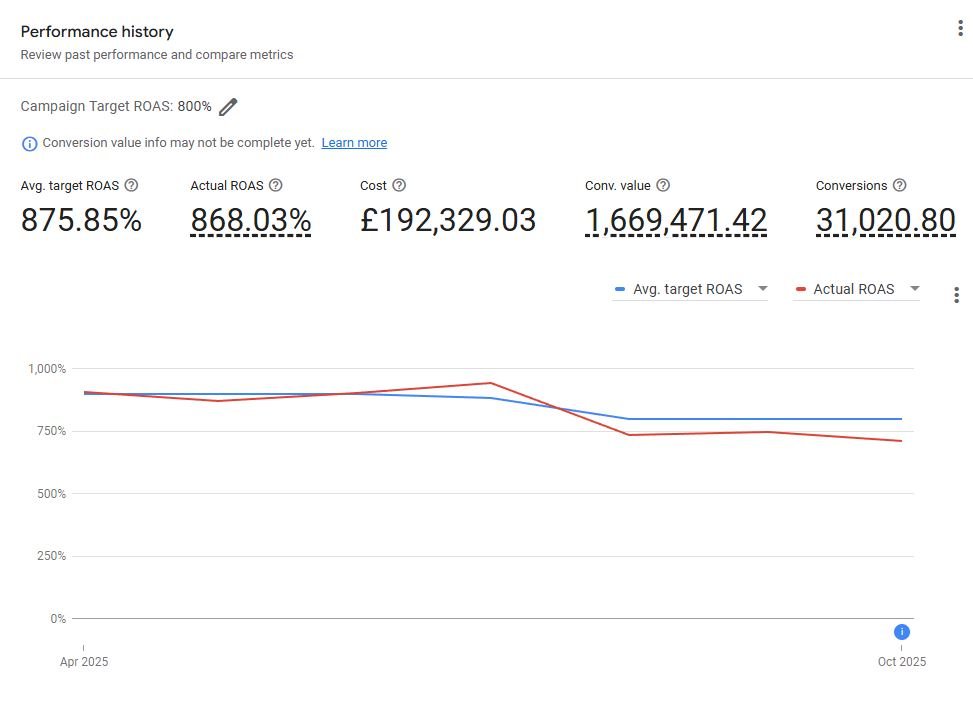
The ROAS target is wrong.
Not wrong in the sense of being slightly off. Wrong in the sense that the business is targeting a number below their break-even ROAS — meaning every sale generated by their ads is producing a loss. The dashboard shows a healthy ROAS. The P&L shows something different. Nobody has connected the two.
We have seen this on accounts across multiple industries, spending anywhere from £1,000 to £15,000 per month on Google Ads. In most cases it has been running for over a year before anyone catches it.
"A 4x ROAS sounds strong. Whether it is strong depends entirely on your gross margin — and most agencies never ask what that is."
WHAT BREAK-EVEN ROAS ACTUALLY MEANS
ROAS — Return on Ad Spend — measures revenue generated per pound spent on advertising. A 4x ROAS means every £1 of ad spend generates £4 of revenue. This is how your platform reports it, how your agency presents it, and how most of the industry talks about it.
The problem is that revenue is not profit. Between the revenue from a sale and any actual money being made sit a series of costs: the cost of the product (COGS), fulfilment, payment processing, platform fees, and in many cases returns. The ROAS your ads need to achieve to cover those costs before generating any profit is your break-even ROAS — and it is almost never the number your agency is targeting.
Where gross margin % = (Revenue − COGS) ÷ Revenue. This is the minimum ROAS at which ad-driven revenue covers the cost of goods. It does not account for fulfilment, returns, or platform fees — those reduce the viable margin further and push the break-even ROAS higher.
A business with 25% gross margin needs a minimum 4x ROAS just to cover cost of goods. But that 4x does not account for fulfilment costs, payment processing fees, returns, or the agency management fee. Once those are included — which they always should be — the actual break-even ROAS for most businesses with 25% gross margin is closer to 5.5–6.5x.
If that business is targeting 4x ROAS, they are not running profitable advertising. They are running a revenue generation machine funded by margin erosion — and the damage compounds quietly until the cash position forces a conversation nobody wanted to have.
THE COMPLETE BREAK-EVEN CALCULATION
The formula above is the starting point, not the complete picture. A proper break-even ROAS calculation accounts for every variable cost that hits an ad-driven sale:
In this example, a business with a 35% gross margin on paper has a contribution margin of 17.9% once fulfilment, shipping, returns, and payment processing are accounted for. Their break-even ROAS is 5.59x — not 2.86x (which is what the gross margin alone would suggest).
If they are targeting 4x ROAS, they are losing approximately £2.96 on every ad-driven order. At a volume of 200 orders per month through paid search, that is a £592 monthly loss dressed up as a 4x ROAS success story.
HOW TO CALCULATE YOURS
You need three things: your average gross margin percentage, your average fulfilment cost per order, and your returns rate. Payment processing fees are usually a fixed formula you can look up in your e-commerce platform or payment provider dashboard.
Once you have those numbers, the calculation takes five minutes. We have built a tool that does it for you — the Contribution Margin & Minimum Price Calculator maps every variable cost against your selling price and outputs the contribution margin and break-even ROAS specific to your products and cost structure.
More importantly: once you have the correct break-even ROAS, you have the minimum number to input into every campaign as your target. Smart Bidding will then optimise toward that threshold rather than below it. For most accounts, this single change is worth more than any campaign restructure.
WHAT TO DO IF YOUR CURRENT TARGET IS BELOW BREAK-EVEN
The answer is not to immediately increase every ROAS target across every campaign simultaneously. Smart Bidding algorithms respond to sudden target changes by reducing spend while they relearn — which can cause a short-term revenue drop that panics people into reverting the change before it has had time to settle.
The correct approach is to increase targets incrementally — 0.5x steps over 2–3 week periods — monitoring impression share and conversion volume at each step. Some campaigns will absorb the increase with minimal disruption. Others, particularly those targeting more competitive or lower-margin product categories, will reduce spend significantly. That reduction is not a problem. It means the algorithm is no longer buying revenue at a loss.
Alongside the target adjustment, the product-level work matters as much as the bidding. Not all products have the same margin, and applying a single ROAS target across a mixed-margin catalogue means high-margin products are held to the same standard as low-margin ones. The correct answer is product-level segmentation — which is what the dynamic labelling system we use is built to deliver.
But the starting point, before any of that, is calculating the correct break-even ROAS for your actual cost structure. Everything else follows from that number.
BREAK-EVEN ROAS.