// Cycling distribution · 70,000 SKUs · Google Shopping
Managing 70,000 products in a single Google Ads account — most campaigns treating every SKU identically regardless of margin or performance.
The existing setup had no campaign segmentation by margin or performance. High-margin products were competing for budget against loss-making lines. The Shopping feed had over 200 disapproved products — inventory that simply wasn't serving. Standard campaign structure meant the algorithm had no way to distinguish a £40-margin product from a £2-margin product.
Dynamic labelling waterfall implemented — five campaign tiers, products moving automatically
200+ feed errors resolved — previously invisible inventory now serving
CSS partnership activated — 20% reduction in click costs from day one
High-margin SKUs now receiving priority budget — profitable revenue compounding
// Sports distribution · £4M revenue · break-even ROAS discovery
A business generating strong ROAS numbers — and losing money on ad-driven revenue without knowing it.
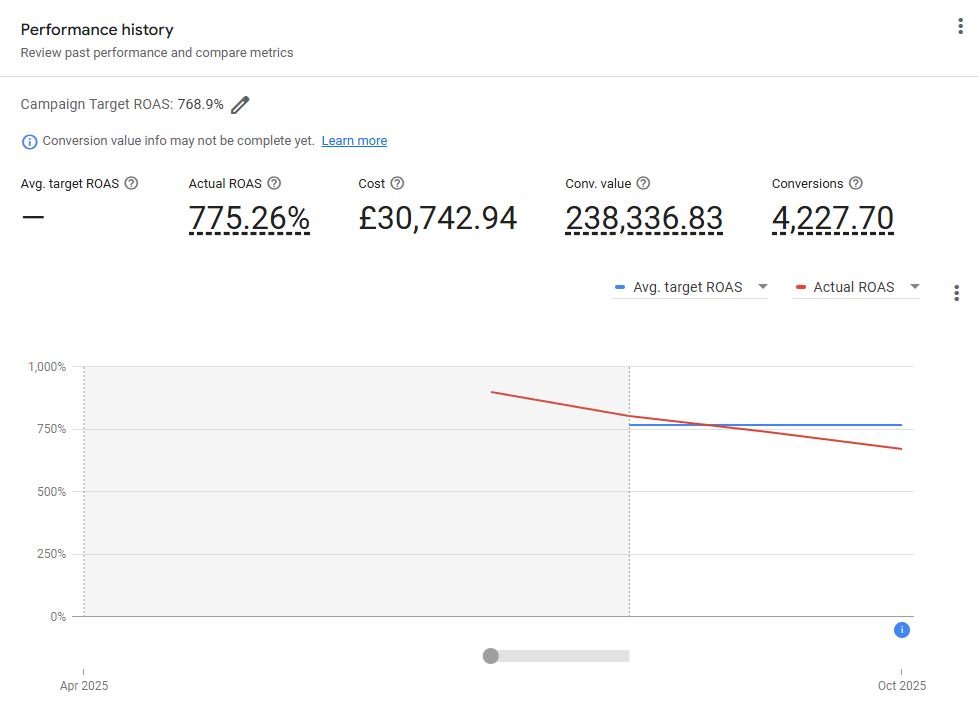
Before our audit, the client's ROAS target was 4x. On paper, campaigns were performing. In commercial reality, their average gross margin was 21% — making their break-even ROAS 4.76x. Every sale generated by ads below that threshold was actively losing money. This had been running for over 14 months before we identified it. The fix was not a platform change — it was a fundamental recalibration of what success looked like.
Break-even ROAS calculated at 4.76x vs 4x target — margin gap identified
ROAS targets recalibrated across all campaigns — bidding for profit, not volume
Product-level P&L mapped — 34 loss-making SKUs excluded from all campaigns
Ad-driven margin transformed within 90 days of engagement
// Home & garden brand · Amazon + Google · dual channel
A growing brand running Amazon and Google in isolation — two agencies, no shared data, cannibalising results.
The brand had separate agencies managing Amazon and Google, with no communication between them. Amazon sales were attributed to Sponsored Products that were actually being driven by Google Shopping brand searches. Google campaigns were bidding against Amazon's own sponsored listings on the same branded terms. The channel conflict was costing the brand on both sides — and neither agency could see it because neither had the full picture.
Both channels brought under one management — full commercial picture visible
Amazon Marketing Cloud deployed — cross-channel attribution finally accurate
Brand term bidding strategy rationalised — budget duplication eliminated
Supplier pricing issue flagged — three product lines returned to profitability
// Barber & salon furniture · high-value products · long consideration cycle
A specialist barber and salon furniture brand — average order values of £800–£4,000 — running Google Ads with the same bidding logic as an impulse-purchase retailer.
The brand sold premium barber chairs, salon stations, and backwash units direct to professional buyers. The sales cycle was anywhere from two weeks to three months — customers researching, comparing, consulting colleagues, then purchasing. Standard Smart Bidding was optimising for 30-day conversion windows, effectively penalising every campaign because the algorithm saw almost no conversions in its assessment period. Budget was being cut from the highest-intent search terms — "barber chair UK supplier", "salon furniture direct" — precisely because they hadn't converted within the window Google was measuring. Meanwhile, generic upper-funnel terms were getting spend because the odd impulse enquiry ticked through faster.
Conversion windows extended to 90 days — algorithm finally seeing the full purchase cycle
Bidding strategy shifted to target impression share on high-intent commercial terms during research phase
Remarketing sequences built for 30, 60, and 90-day consideration windows — staying visible through the full decision process
Lead form introduced for sample requests — micro-conversions giving the algorithm signal without waiting for a £2,000 purchase
Enquiry volume increased significantly within 60 days as budget was reallocated to correct intent signals